Happy Birthday America! July 4, 2026
"Any people anywhere, being inclined and having the power, have the right to rise up and shake off the existing Government, and form a new one that suits them better. This is the most valuable, and sacred right--a right which, we hope and believe, is to liberate the world. Nor is this right confined to cases in which the whole people of an existing Government may choose to exercise it. Any portion of such people that can, may revolutionize, putting down a minority, intermingled with, or near about them, who may oppose their movements. Such minority was precisely the case of the Tories of our own Revolution. It is a quality of revolutions not to go by old lines, or old laws; but to break up both, and make new ones." Jan 12, 1848 Abraham Lincoln, in the House of Representatives.
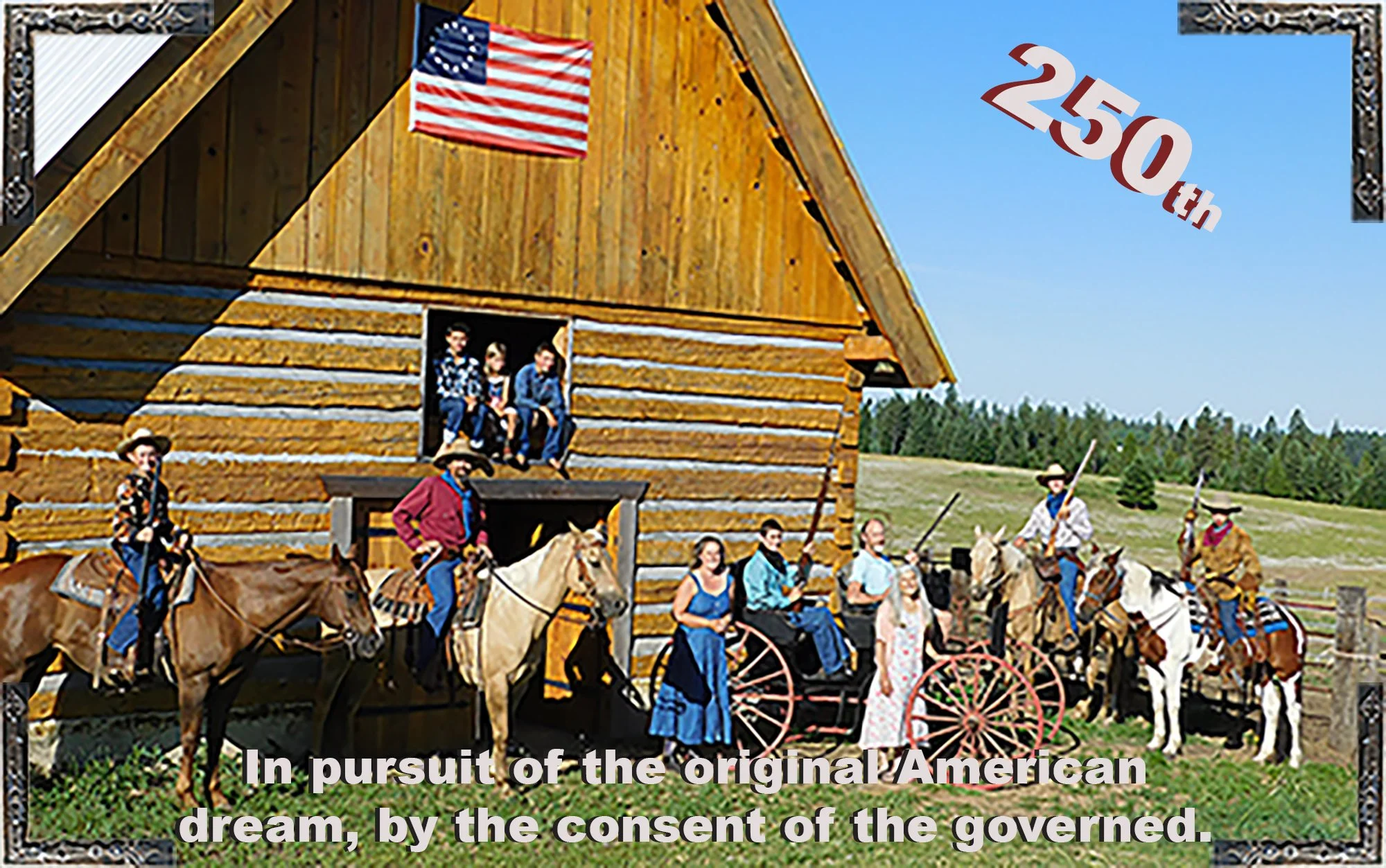
As we enter the new year of 2026, the American people will celebrate 250 years since the signing of the Declaration of Independence.
In the 17th century, William Penn, (founder of the State of Pennsylvania) had envisioned a new world of rich land with abundant resources ready to be inhabited by a new society. Another old-world man John Locke who influenced the English Bill of Rights was refining his philosophy on the origin of government. He observed that governments were set up to secure property. [1] Government was based on the consent of the people--a government that could be altered or abolished by their choice.[2] By the beginning of the 18th century America was ripe for the application of these ideas into a representative government which developed within each of the thirteen colonies.
In 1776, Thomas Jefferson with the same visionary philosophy of his ancestors put into words what those in his time felt by authoring the Declaration of Independence. This remarkable document respectfully demanded that the inhabitants of the former 13 colonies be treated as "Free and Independent States".[3] Then "in the Second year of the Independence of America"[4], a congress of representatives from each of these new States agreed "to certain articles of Confederation and perpetual Union".[5] After an eight year struggle against the most powerful military force in the world, each of the former thirteen colonies were recognized as free and independent States in the Treaty of Paris in 1783.
Before this, the people’s movement westward had been nearly halted by the distant British government. Now land towards the west could be settled and owned by brave families willing to endure incredible hardships and sometimes death.[6]
A common man could participate in a local representative form of self-government. He had elbow room to create a business, marry, and raise a family. Marriage and family gave him the reason to work and live.
The opportunity available for a man to build a traditional family who could work beside him came from his ability to own property in the form of land and a small business. He could participate in a representative government to guarantee those rights. This opportunity could be called "The American Dream”.[7]
However, eleven years after the creation of the Confederation, influential men in the aristocracy argued that changes to the Confederation's constitution were necessary to create a more energetic central government.[8] But not everyone agreed to such changes of what they feared would produce a consolidation of the States[9].
Some held that republics worked best in small geographic locations.[10] Men like Patrick Henry from Virginia, and a large “Minority of the Convention of Pennsylvania”, along with many others were opposed to changing the current constitution which clearly recognized the sovereignty of the individual States[11].
After great debate among the States ratifying conventions, a new constitution was adopted in 1789, after satisfying the earlier objections with a Bill of Rights. The Bill of Rights placed limitations on the central governments legislative powers by the States, thus forming a new “Confederacy” as George Washington and future American Presidents were to call it.[12]
Despite this safeguard, over the next 247 years representative government, land, small business, and the traditional family went through significant changes. The American Dream changed too.
Representative Government Additional amendments to the new constitution changed the confederacy of States into a centralized democratically elected powerhouse. The idea of "implied powers" superseded the earlier limitation of “expressed powers” found in the ninth and tenth amendments of the Bill of Rights. It had been a compact between sovereign States.[13]
Now it became a forced union of states, headed by an out-of-control central government ruling from a distance with usurped power.[14]
Land Large tracts of the choicest land east and west of the Mississippi River were quickly purchased by land speculators with political backing at much lower rates than the preemption prices individual families spent.[15] Railroads were gifted giant allotments of land by the central government. Then timber companies bought and controlled massive amounts of land from the railroads and in one instance created the largest sawmill in the world.[16] Finally, the central government retained from 28 to 86 percent of the land in eleven western states violating what is called "The equal footing doctrine”.[17] These actions reduced the quality and quantity of low cost land available for settlement by individual families.
Small Business Local small family businesses were displaced by the growth of large corporations who were legally recognized as a “person” and given protection from state regulation by the central government.[18] The family became separated from their land and each other. They began to work for large corporations in urban or rural locations. A twenty to forty year indenture to a corporation replaced the idea of family business ownership. Creativity in design and personal satisfaction in quality work by a self-employed craftsman was replaced by the priority of high efficiency and production within the corporation.
The Traditional Family Education within trades and apprenticeships were replaced by ever increasing time invested in scholastic education. Children were viewed as liabilities instead of assets. Families became smaller and marriages were easier to split apart. The people were divided into individuals. Individually they would be managed within a corporate family.
To summarize: A change in the representative form of government created a ripple effect that impacted property distribution in the settlement and creation of new states. Regulation of small business, and trades gave an unjust advantage for the growth of large corporations. The traditional family was economically affected in a negative way and as a result became divided and turned to large corporations for employment and survival. This has become the new American Dream.
***************************************************
The two American dreams past and present have been compared. For those who have an interest in America’s freedom, it is important to decide which American Dream best preserves the vision that the author and signers of the Declaration of Independence intended for their posterities’ future. Will the traditional family survive another 250 years or are we left only with a system which prepares children to belong to a corporate family? For those who wish to see the traditional family preserved into the future American Dream, deliberate planning and perseverance in the areas below will be needed.
Traditional Marriage A traditional family starts with a traditional marriage based on biblical principles. Men and women are two distinctly different people physically and mentally. The different roles each play within the family government complement perfectly what is necessary to create a traditional family.
Land Ownership The ownership of land by the traditional family gives stability and independence to allow a growing family space to build a small family commonwealth for the benefit of all its members. A growing family is utilized to its fullest capability and best trained by participation in agricultural activities. It is capable of operating an efficient small-scale diverse farm to supply many of its needs while teaching work ethic and business management skills at a young age.
Small Business Ownership The ownership of a small business by the traditional family gives flexibility in balancing time spent in scholastic versus manual education in trades. Pairing a trade with the farm is necessary to "trade" for what you need and do not produce yourself.
Representative Government Representative government begins at home with the head of the house. Educate your family on how a representative government was designed to function. Elect government representatives who favor preserving the original American Dream.
Today this would mean electing representatives in all three branches of state and federal government who would prioritize their time to support or introduce legislation to:
-- Eliminate unelected bureaucracies which threaten local family government and the traditional family.
-- Transfer and re-title land in the western states which rightfully belong to the people within the state.
-- Protect small businesses by upholding the right of the people to freely contract with each other without regulation and remove legal protection for large corporations from state regulation.
-- Uphold local control in decision making by the people within their States to decide what is best for them. In sum, a deconsolidation of the central government to function within expressly delegated powers by the States and the people according to the 9th and 10th amendments in the Bill of Rights.[19]
To conclude, the result in individual investment of time in the actions stated above will create communities composed of traditional families, who have the creative power to own land and build a small business. A population who possess similar lifestyles, customs, and values will function best in a local representative government within a confederated republic of sovereign States.
Families who follow this example will pass the legacy of the original American Dream onto the next generation. The Declaration of Independence will remain relevant for us today and into future.
Does this sound too good to be true? It isn’t, because we see this successful model happening around us! John Locke, Thomas Jefferson, and Abraham Lincoln were right. The people will ultimately decide. This is what freedom is.
[1] “The reason why Men enter into Society is the preservation of their Property.” Two Treatises of Government, book 2, Chapter XIX, John Locke, Of the dissolution of Government, section 222.
[2] Ibid. “…whenever the Legislators endeavor to take away, and destroy the Property of the people….they put themselves into a state of War with the People, who are thereupon absolved from any further Obedience, and are left to the common Refuge, which God hath provided for all Men, against Force or Violence. Whensoever therefore the Legislative shall transgress this fundamental Rule of Society… or put into the hands of any other an Absolute Power over the Lives, Liberties, and Estates of the People; By this breach of Trust they forfeit the Power, the People had put into their hands, for quite contrary ends, and it devolves to the People, who have a Right to resume their original Liberty, and by the Establishment of a new Legislative (such as they shall think fit) provide for their own Safety and Security, which is the end for which they are in Society.”
[3] The Declaration of Independence
[4] Articles of Confederation
[5] Ibid
[6] History Of The Westward Movement, Frederick Merk
7] The House Divides The Age of Jackson and Lincoln, from the War of 1812 to the Civil War, Author Paul I. Wellmam, calls this “a dream” on page 23.
[8] The Federalist Papers
[9] The Anti-Federalist Papers. The same fear of “one Consolidated Government” was echoed nearly 50 years later by President Andrew Jackson in his Farewell Address. Jackson was the only American President to successfully pay off the national debt and abolish the central banking system of his day.
[10] “We dissent, first, because it is the opinion of the most celebrated writers on government, and confirmed by uniform experience, that a very extensive territory cannot be governed on the principles of freedom, otherwise than by a confederation of republics, possessing all the powers of internal government; but united in the management of their general, and foreign concerns”, The Address and Reasons of Dissent of the Minority of the Convention of Pennsylvania to their Constituents ( Dec. 18, 1787)
[11]“The fate of this question and America may depend on this: Have they said, we the States? Have they made a proposal of a compact between States? If they had, this would be a confederation: It is otherwise most clearly a consolidated government. The question turns, Sir, on that poor little thing—the expression, We, the people, instead of the States of America….Had these principles been adhered to, we should not have been brought to this alarming transition, from a Confederacy to a consolidated Government.”-June 5, 1788 Patrick Henry.
[12] The Writings of George Washington, vol. 9, pages 389, 390. Alexander H. Stevens quotes from Andrew Jackson’s first inaugural address found in the Statesman’s Manual, vol. 2, page 695 “In such measures as I may be called to pursue, in regard to the rights of the separate States, I hope to be animated by a proper respect for those Sovereign members of our Union; taking care not to confound the powers they have reserved to themselves, with those they have granted to the Confederacy”
[13] A Constitutional View of The Late War Between The States: Its Causes, Character, Conduct And Results (Vol. 1), Alexander H. Stevens
[14] The Constitution in Exile, Judge Andrew P. Napolitano
[15]History Of The Westward Movement, Frederick Merk
[16] Company Town, Keith Peterson
[17] Storm over Rangelands: Private Rights In Federal Lands, Wayne Hage
[18] Divided We Stand, Walter Prescott Webb
[19] Sovereign Duty, KrisAnne Hall, JD